9 hr
Full-Day Albanian Heritage Tour from Saranda
Discover six iconic sites including Gjirokaster, Blue Eye spring, and historic Ottoman landmarks
Reserve
Hand-picked by our editors — only the best 5 tours from 47 reviewed.
Verified partners for every tour, free cancellation where available, and instant confirmation on every booking.
9 hr
Discover six iconic sites including Gjirokaster, Blue Eye spring, and historic Ottoman landmarks
Reserve
8 hr
Journey through Albania's cultural treasures and natural wonders on this comprehensive guided excursion
Reserve
7 hr
Explore UNESCO heritage sites, natural wonders, and historic fortresses in a single unforgettable day
ReservePrices from verified partners. Availability updates in real time at checkout. Free cancellation policies apply where shown.
The landmarks, rooms, and views travelers on this tour remember — all visible on a single visit.
Contains a wide collection of cannons and military hardware used throughout Albanian history.
Guided excursions offer seamless logistics and curated narratives, while self-guided travel grants total freedom over your schedule. The blue eye and gjirokaster tour from saranda tours typically prove superior for those prioritizing efficiency and local historical context.
| Feature | Top pick Guided Tour | Independent Exploration |
|---|---|---|
Logistics |
Pre-arranged transport and timing | Self-managed transit and scheduling |
Navigation |
Driver-led route management | Manual map and GPS navigation |
Pace |
Structured, fixed itinerary | Fully flexible and self-directed |
Depth of Local Context |
Professional guide commentary | Self-study via guidebooks or app |
Opportunity for Spontaneity |
Limited to planned stops | High flexibility for detours |
Cost Efficiency |
All-inclusive single price | Variable based on fuel and dining |
| See tickets → |
Verdict: Choose a blue eye and gjirokaster tour from saranda if you prefer a stress-free experience, or opt for independent travel if you require complete control over your visit to the stone city and nearby natural landmarks.
Choose your ticket, select your date, and reserve in under two minutes. Secure checkout handled by our verified partner.
Instant confirmation by email, with a mobile voucher you can save offline. No printing, no queuing at a collection desk.
Arrive at the entrance, show your voucher on your phone, and walk in. Most tickets include priority or skip-the-line access.
Practical details for your visit straight from our verified partners — hours, access, rules, and how to get there.
Rruga Elvia Celebi
Main entrance point for all visitors.
Follow SH4 road via Drino Valley; paid parking available near the entrance.
Wear comfortable walking shoes with good grip, as the cobblestone paths and limestone ramps inside the fortress can be steep and slippery.
There are no lockers or formal bag storage facilities available; travel light as you will be navigating stairs and uneven terrain throughout your blue eye and gjirokaster tour from saranda.
Photography is permitted throughout the grounds, including the artillery gallery and the ramparts where the aircraft is displayed.
The fortress features uneven stone surfaces, steep inclines, and stairs, making it challenging for visitors with limited mobility.
Mobile phone coverage is generally good throughout the site, though connectivity may be limited inside the thick-walled tunnels.
The site is expansive and generally family-friendly, though parents should supervise children closely near the historic wall edges and ramparts.
A small cafe is located within the ramparts where you can purchase refreshments; it is recommended to carry bottled water during summer.
Pets are generally not permitted inside the museum exhibit areas within the fortress.
Ensure you have sufficient local currency in ALL, as the ticket office does not accept cards or foreign currency for your blue eye and gjirokaster tour from saranda.
Best time to go, insider tips, nearby landmarks, and the cancellation fine print — flip through to skim what matters to you.
How crowds, weather, and events shift across the year.
High season with sunny, hot days; ideal for early morning photography.
Small details that turn a good visit into a great one.
Visit at opening or after 16:00 to avoid large group arrivals.
Non-bookable sights within a short walk — free to visit, easy to pair.
Historical market street known for traditional crafts and stone architecture.
Flexible, no hidden fees.
Full refund available for cancellations made within the specified window. Please verify terms with your specific provider.
Hand-picked options within walking distance — pick a district for vibe, or a specific hotel for convenience.
Traditional stone houses converted into charming guest accommodations.
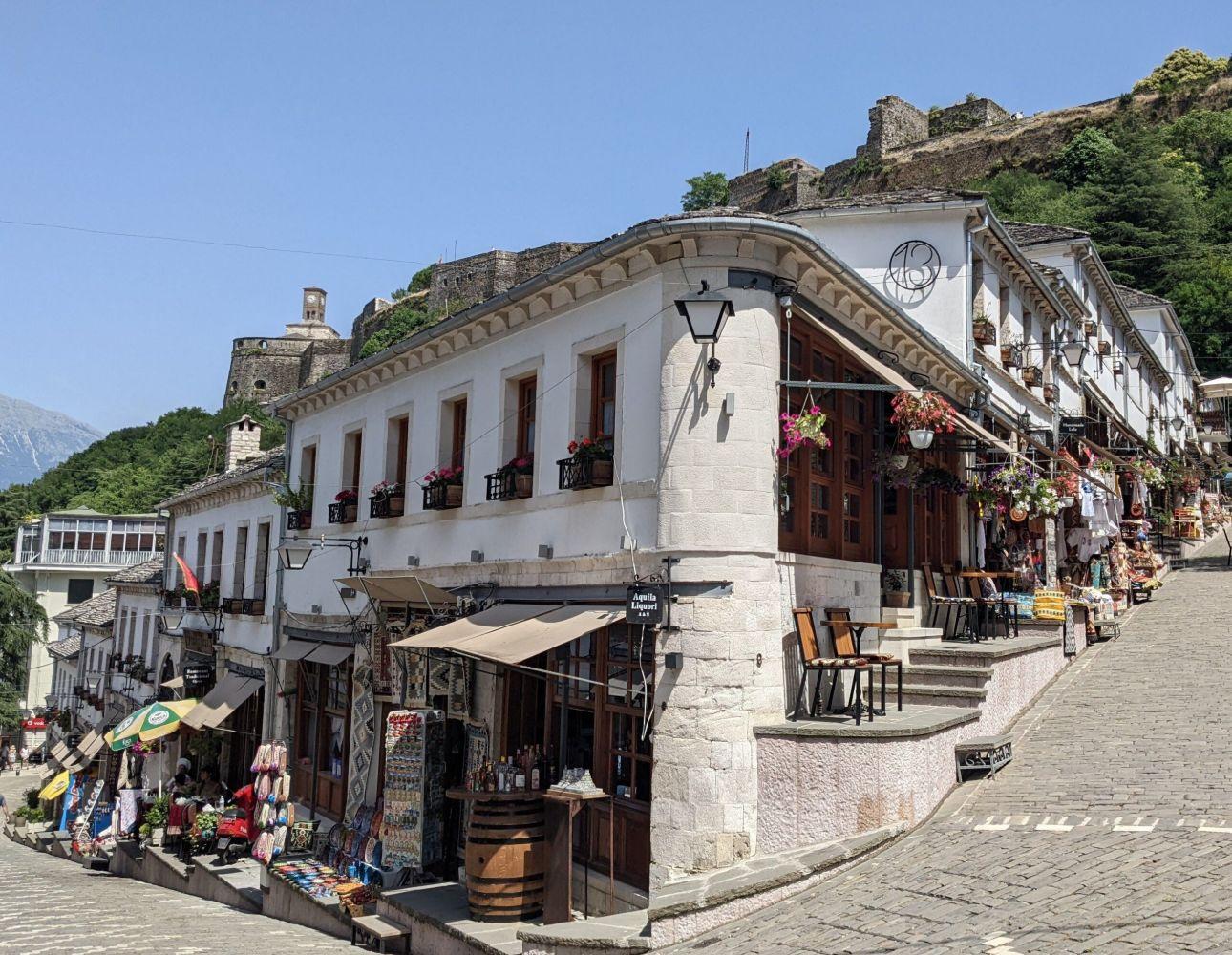
The road from Saranda climbs 300 metres through the Drino valley, leaving the Ionian behind for a landscape of limestone ridges and oak forest. Gjirokastër's silhouette appears first as a cascade of slate roofs, each house stepped above the next in Ottoman precision, the fortress perched at the summit like a stone crown. UNESCO inscribed the city in 2005, recognizing not just the fortress but the entire Ottoman-era core — 600 stone houses, their upper storeys cantilevered over cobbled lanes, many dating to the 17th and 18th centuries. The fortress itself predates the Ottomans by seven centuries, its walls enclosing five towers, an armory housing a captured American jet from the Cold War, and terraced ramparts offering unbroken views across the valley to the Greek frontier. Twenty kilometres north, Syri i Kaltër — the Blue Eye — reverses the architectural severity of the city with pure natural spectacle. The spring erupts from a karst sinkhole more than 50 metres deep, discharging 6,000 litres of glacial water per second at a constant 13 degrees Celsius. The eye's centre pulses cobalt, fading through turquoise bands to pale jade at the edges, the chromatic gradient a product of depth and mineral suspension. Soviet-era researchers attempted to measure the source's full depth in the 1990s and failed beyond 50 metres; the aquifer's true extent remains unknown. Plane trees shade the banks, and wooden footbridges cross channels where the spring fans into the Bistrica river. Blue eye and gjirokaster tour from saranda itineraries typically allocate three hours for the fortress and old town, one hour at the spring, with roadside stops at Lekursi Castle's belvedere and occasionally the ruins of ancient Antigonea. The pairing works because the sites contrast in character — Gjirokastër rewards slow observation of architectural detail and historical layering, while the Blue Eye offers immediate sensory immersion. Tours depart Saranda between 08:00 and 09:30, returning by late afternoon, covering roughly 120 kilometres round-trip on good asphalt but winding mountain grades. Guides narrate Albania's Ottoman and communist legacies, the fortress's role in successive occupations, and the geology that feeds the spring. The combination remains the most-booked excursion from Saranda, pairing southern Albania's two most distinct UNESCO and natural landmarks in a single traverse.
"The spring erupts from a karst sinkhole more than 50 metres deep, discharging 6,000 litres of glacial water per second at a constant 13 degrees Celsius."
A step-by-step walkthrough of the visit — what you'll see, how long each stage takes, and the details that matter.
You meet your group in Saranda's central plaza at 09:00, boarding an air-conditioned coach for the hour-long climb into the mountains. The coach pulls into Gjirokastër's lower car park by 10:15, and you walk the final 200 metres uphill to the fortress gate, entering through a vaulted Ottoman portal. Your guide leads you along the southern rampart, pausing at the clock tower for a panorama of the valley, then descends into the fortress interior where Cold War–era tunnels and the aircraft hangar occupy the central courtyard. You spend 40 minutes exploring the towers and museum galleries before descending into the old town, walking narrow lanes past stone houses with carved wooden balconies, stopping briefly at the ethnographic museum. By 12:30 you re-board for the drive north to the Blue Eye, arriving 40 minutes later. You follow a footpath through the plane-tree grove, the sound of rushing water growing louder, until the spring pool appears below — a perfect circle of layered blue, the centre pulsing darker where the aquifer vents upward. You cross the wooden bridge for photographs, feeling the temperature drop near the water, watching the current churn white at the pool's edge before spreading into shallow channels. At 14:00 the group regroups for the return journey, often with a brief stop at Lekursi for a final view over Saranda and the coastline, reaching the city by 16:00.
There are no formal timed slots or skip-the-line tickets for the fortress; admission is paid via cash at the gate upon arrival.
The Gjirokastër Fortress is open daily from 09:00–19:00.
No, the ticket office at the fortress only accepts Albanian Lek (ALL) in cash.
Allow 1.5 to 2 hours to fully explore the fortress grounds and museum exhibits.
Yes, it is family-friendly, but be prepared for steep, uneven surfaces and keep children away from wall edges.
The most convenient way is by private car or booked transfer, allowing a stop at the Blue Eye spring along the SH4 road.
Yes, photography is permitted throughout the complex, including the military museum and aircraft exhibits.
Bring cash in ALL, sunscreen, a hat, and comfortable walking shoes with good grip.
Yes, you can hire local guides at the gate to explain the history of the Gjirokastër Fortress, which is often not detailed on museum signage.