English| EUR
Suggested for you
More currencies
Choose a language
The coastal town of Saranda and the UNESCO-listed Stone City of Gjirokastër sit 55 kilometers apart, connected by a single mountain road that climbs 800 meters in elevation. Understanding the saranda to gjirokaster time—and what affects it—shapes every visitor's logistics between beach and bazaar. This guide covers journey duration by transport mode, the factors that stretch or compress travel time, and how to sequence your arrival with the castle's opening hours.
Quick answer
The saranda to gjirokaster time ranges from 45 minutes to 1.5 hours depending on transport mode. Private vehicles and taxis complete the 55-kilometer mountain route in 45-60 minutes under normal conditions. Public buses take 1.5 hours due to coastal stops in Ksamil and Blue Eye turnoff. The winding SH99 road adds 15-20 minutes during summer peak season when coach traffic intensifies and livestock crossings slow ascent through Muzinë pass.
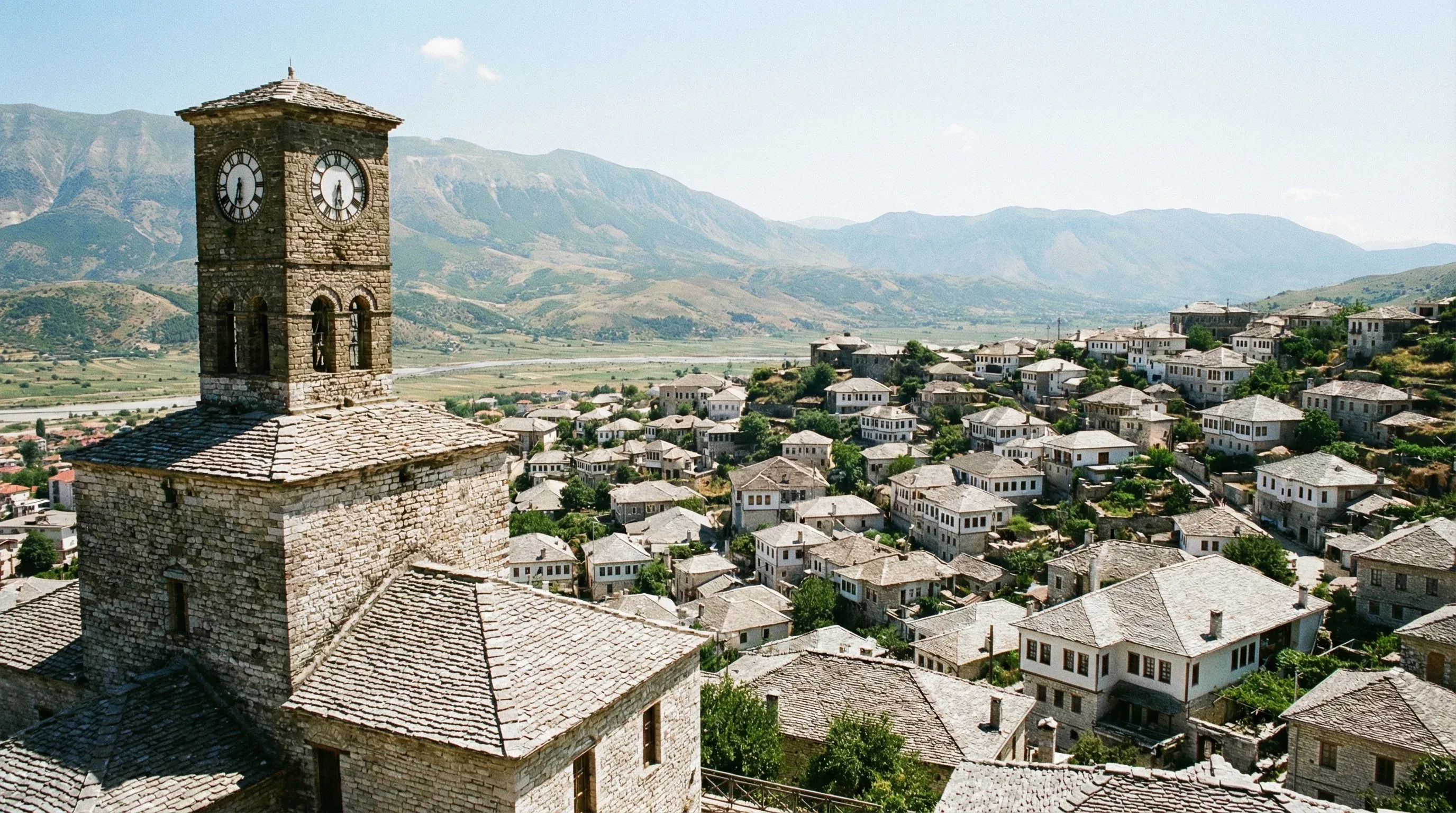
The SH99 corridor between Saranda and Gjirokastër carries more than elevation—it compresses centuries. Coastal travelers leave sea-level tavernas at breakfast and reach Ottoman stone lanes by mid-morning, threading a route that Yugoslav engineers carved through karst ridges in the 1960s. The saranda to gjirokaster time answer depends less on distance than on geometry: the road gains 800 vertical meters in 40 switchback kilometers, each hairpin bend framing either the Ionian coast behind or the Drino valley ahead. Transport mode determines baseline duration. Rental cars and private taxis execute the route in 45-60 minutes when traffic flows freely, though drivers unfamiliar with Balkan mountain roads often add 10 minutes in cautious negotiation of blind curves near Muzinë. Public buses—principally the Saranda-Gjirokastër line operated by regional carriers—stretch the journey to 1.5 hours, stopping at Ksamil beach access and the Blue Eye spring turnoff before beginning the sustained climb. Shared furgons, the minivans that dominate Albanian intercity travel, split the difference at 70-80 minutes, departing only when passenger capacity fills. Seasonal and daily rhythms reshape the baseline figures. July and August bring tour coaches from Corfu ferry arrivals, their bulk slowing uphill lanes and adding 15-20 minutes to morning ascent. Afternoon return traffic compounds the effect: coaches descending toward Saranda between 15:00-17:00 force private vehicles into extended passing waits on narrow sections above Labovë e Kryqit. Livestock crossings through the Muzinë corridor—goats and sheep moved between pasture zones—introduce unpredictable 5-10 minute pauses, most common at dawn and dusk during transhumance seasons in spring and autumn. The castle opens at 09:00 daily, and the saranda to gjirokaster time guide recommends departure no later than 08:00 to reach Gjirokastër's lower town parking zones by 09:00-09:30. Early starts avoid both coastal departure queues and the 10:30-11:00 arrival pulse of organized day tours. Travelers continuing to Përmet or the Vjosa valley benefit from positioning Gjirokastër as a morning stop, leaving the afternoon return window for the coast's 19:00 summer light.
“The road gains 800 vertical meters in 40 switchback kilometers, each hairpin bend framing either the Ionian coast behind or the Drino valley ahead.”
Gjirokastër is located approximately 55 kilometers northeast of Saranda, accessible primarily via the SH4 national road. Most travelers complete this journey by car or local bus, navigating through the scenic mountain terrain between the coast and the interior.
SH4 national road
Saranda Bus Terminal to Gjirokastër
Private hire via SH4
For the smoothest transition into your visit, aim to arrive within the recommended morning window to secure parking near the town center before peak visitor numbers increase.
The best arrival window is 09:00–10:30 to beat the heat and mid-morning coach crowds. Planning your arrival for this early timeframe ensures a quieter experience before the peak daily influx.
Mild, 18-24°C
Cooler temperatures make walking the steep stone streets more manageable.
Hot, 30-35°C
High temperatures peak by midday; early arrival is essential.
Pleasant, 20-25°C
Stable weather and thinner crowds provide ideal sightseeing conditions.
—
Mid-week visitors encounter fewer day-trip groups from coastal areas.
Verdict: Visit Tuesday to Thursday, arriving at 09:00, during the months of May or September.
The site is open daily to accommodate visitors traveling from Saranda. Regular operating hours apply throughout the week.
This plan suits day-trippers arriving mid-morning and covers approximately 4–5 hours in Gjirokastër, allowing time for the castle, old town exploration, and a meal before your return journey.
Head straight to the castle entrance on Rruga Elvia Celebi. Pay the 400 ALL conservation fee and begin with the clifftop fortifications for orientation across the valley.
Walk through the former prison cells, the armory collection, and the Cold War tunnel. Budget 60–90 minutes to cover the main zones without rushing.
Walk downhill through the cobbled lanes toward the bazaar district. The stone streets and Ottoman-era houses form the historic core worth 30–40 minutes of wandering.
Choose a traditional restaurant near Cerciz Topulli Square. Local trout and qifqi (rice balls) are typical; most spots serve quickly.
Tour one of the preserved tower houses to see original carved ceilings and period furnishings. Each visit takes roughly 20–30 minutes.
Allow time to return to your pick-up point or taxi stand. The walk back to the main square takes 10–15 minutes from most old-town locations.
Everything you need to know about saranda to gjirokaster time
The typical saranda to gjirokaster time for a direct drive or bus journey is approximately 1 to 1.5 hours. Travel duration depends heavily on traffic conditions along the coastal and mountain routes.
Yes, local buses frequently operate the route between these two destinations throughout the day. It is recommended to check local schedules in advance to align with your preferred travel window.
To maximize your visit to this UNESCO World Heritage site, arrive between 09:00 and 10:30. This window helps you beat the heat and avoid the mid-morning coach crowds arriving from the coast.
While a private car allows for a more flexible schedule, the public bus remains a reliable and cost-effective option for many visitors. Regardless of your mode of transport, planning your arrival early remains the most effective way to enjoy the stone city.
Several local operators offer organized excursions that manage all logistics for your trip. These tours are designed to optimize your time and provide deeper insight into the historical fortress and old bazaar.
The entrance fee to the site is 400 ALL per person as a conservation charge. Please ensure you have local currency available as this fee is standard for all visitors.